At Delmanor West Village, Registered Kinesiologist Krishna works with residents to promote mobility and longevity. She helps seniors with rehabilitation and works on movement patterns and biomechanics to prevent injury and support active living. Below, we interview Krishna about what this looks like day to day inside Delmanor West Village.
Meet the Expert
Krishna graduated from York University with a kinesiology degree in 2023. A year later, she went back to school and completed a post-graduate program at Humber College, earning a diploma in exercise science and lifestyle management.
From a young age, Krishna worked with children as a coach and camp counsellor. Although she really enjoyed it, there came a point when she realized that wasn’t what she wanted to do with her life. It wasn’t until a placement at Schlegel Villages through her post-graduate program that she found the population she did want to work with: seniors in retirement living.
Krishna fell in love with the atmosphere and the feeling of home that retirement living provides. She also wants to challenge the negative stigma that seniors face. As she says:
Aging isn’t always seen in the most positive light. I really want to help seniors continue to be active and accomplish their goals. I want to work to help diminish the stigma of aging as a negative thing and show that you are not too old to do certain things.
How Do You Help Residents Prevent Falls and Stay Steady on Their Feet?
Krishna takes a multi-dimensional approach that focuses not just on physical mobility, but on each person as a whole.
As a starting point, she completes a fall risk assessment that helps her determine whether someone is more likely to experience a fall. It looks at how many falls a person has had in the last year and whether there is any history of stroke or Parkinson’s.
Following the initial assessment, Krishna asks about lifestyle, nutrition, hydration, and activity levels. She then assesses physical capabilities and functional movement, or simply, the way a person walks and moves around.
From there, Krishna gives each resident exercises to help with those functional movements. For example, walking heel to toe provides more stability than shuffling.
How Do You Assess a New Resident, Personalize a Fitness Plan, and Track Progress?
According to Krishna, assessing a new resident involves talking with them and getting to know them as a person, learning about their medical history, and determining their physical abilities.
She asks whether the person has had any past injuries or surgeries, and about any new or existing medical conditions. To assess physical ability, she looks at range of motion, mobility, and cardiovascular health. For example, how quickly someone becomes tired during a task such as walking, or how easily they can get out of a chair.
When it comes time to personalize a fitness plan, Krishna takes many factors into consideration.
Q: How do you personalize a fitness plan for someone with limited mobility?
Krishna: For those with limited mobility, the start of any program will be in learning how to do the movement. From there, I can progress with them to harder elements, which may include adding more resistance or more equipment to work on strengthening.
Q: How does this differ from someone who is more active?
Krishna: For someone more active, I like to do more dynamic exercises that require a combination of more thinking and movement. One example could be more movements where the person is standing as opposed to sitting.
After each session, Krishna writes notes on the exercises completed and anything the resident found difficult. She records these in a shared spreadsheet that the nurses and personal support workers (PSWs) can access, as can the resident’s family on request. Krishna also makes a point of communicating directly with family members.
What Classes and One-on-One Sessions Are Available?
Krishna leads a variety of group classes, offered several times a week and included in the monthly fee:
- AquaFit, twice a week
- Water volleyball, once a week
- Chair cardio
- Resistance training
- Fall prevention
Q: What is involved in the AquaFit program?
Krishna: It is similar to the classes in the gym, but I add a few more water-specific exercises such as flutter or scissor. I also incorporate water weights, pool noodles, and play music.
One-on-one sessions are also available and billed separately:
| Session |
Details |
Fee |
| 30-minute session |
One-on-one |
$28.50 |
| 45-minute session |
One-on-one |
$42.75 |
| Focus 30 |
30-minute session for a group of three to four residents |
$14.25 |
Krishna sees each resident for a maximum of two one-on-one sessions per week.
How Do You Motivate Someone Who Has Never Exercised Regularly?
Krishna recognizes that not everyone is a fan of exercise, so she works to make each session fun rather than a chore.
“I find out things about their lives such as their previous occupation and their current hobbies and interests,” she says. “I use these things as a point of conversation and to distract them. For example, I have one resident who speaks French. Since I also speak French, we practice French together while she is doing her exercises.”
When residents stick with their programs, Krishna finds they are always surprised by their ability to change their movement patterns and by how much they are able to push themselves.
What Support Is Available After a Hospital Stay or Surgery?
Care in these situations is usually provided by the nurses and PSWs. Residents who would also like rehabilitation with a kinesiologist can book one-on-one sessions with Krishna.
What Should Families Ask About Fitness and Mobility Support When Touring a Retirement Community?
- What facilities are available? Look for a gym or a pool.
- What happens when mobility changes? Ask what protocols are in place for residents who need to be reassessed.
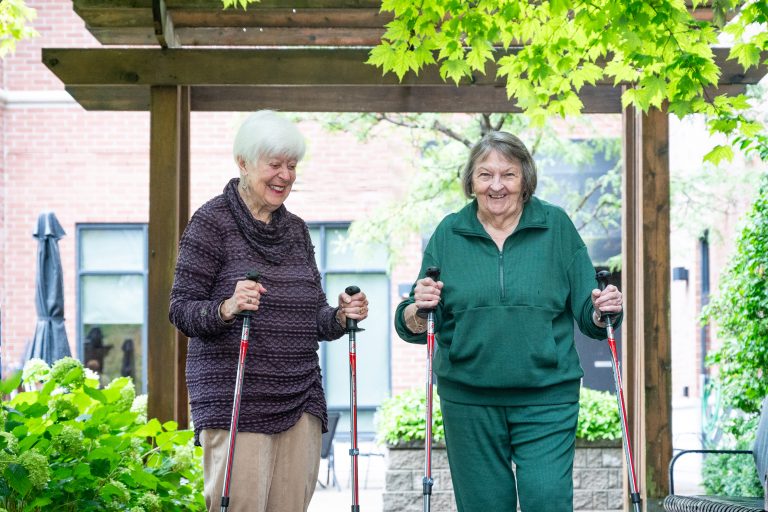
- What support is offered? Notice whether walking poles, canes, and walkers are available, and whether there is an assisted living floor.
Come See It for Yourself
The best way to understand how residents stay active at Delmanor West Village is to see it in person. We would be glad to welcome you and your family for lunch and a personal tour. Visit the gym and pool, meet Krishna and the team, and experience the Delmanor difference for yourself.
Book a lunch and tour at Delmanor West Village
About Delmanor Communities
Delmanor Communities is a proudly Canadian-owned and operated luxury retirement living provider with over 23 years in the industry, operating seven exceptional communities across the Greater Toronto Area as a member of the Tridel Group of Companies. Each community is designed around a simple belief: that retirement should feel meaningful, connected, and inspired. From chef-prepared dining and personalized care plans to curated lifestyle programming and warm, attentive staff, Delmanor Communities is built for seniors who want to live actively, independently, and well. To learn more or book a tour, visit delmanor.com